
Structural Frame Fasteners and Sidelap attachments
Low-rise buildings with a large footprint are common for retail, warehousing, and distribution businesses and offer owners a structure with significant square footage.
Get started designing a roof or floor diaphragm using the PROFIS Engineering Diaphragm Design Module. Register now.
Learn quickly how to design steel deck and concrete-filled roof deck with our PROFIS Engineering Diaphragm design Software demonstration video.
In North America this building type is designed with a stiff lateral force resisting system and is coupled with a flexible roof or floor diaphragm. The vertical elements of the building often include concrete, masonry walls, or braced frames.
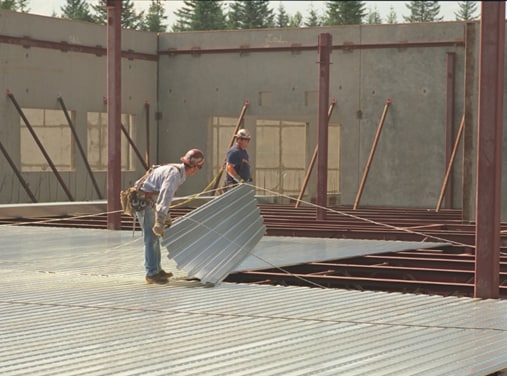
A diaphragm is defined by the American Iron and Steel Institute (AISI) as a roof, floor or other membrane system that transfers in-plane forces to the lateral force resisting system. In low-rise buildings, steel deck is commonly used for flexible diaphragm element.
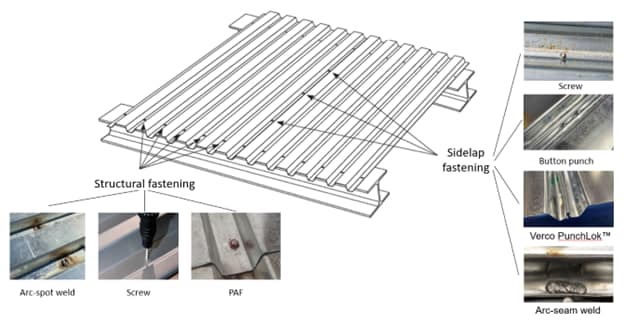
A diaphragm of steel deck is created when single profiled sheets of steel are connected using sidelap fasteners to form one large deck diaphragm. Sidelap fasteners used to connect the sheets of steel together can consist of arc seam welds, screws or crimping fastenings like button punch. The deck itself transfers lateral loads to the lateral force resisting system, such as the columns and beams, through the beneath structural roof framing system via structural fasteners like arc spot welds, screws or powder-actuated fasteners (PAF). Fastener selection for both sidelap connections and structural frame fasteners is often a matter of preference, cost and efficiency, however if the building is in an area of seismic risk, there may be additional requirements a designer may want to consider for design.
Ductile Response of Varying Fasteners
Ductility in seismic design refers to the ability of a structure and its structural components to undergo large amplitude cyclic deformations without a substantial reduction in strength. Seismic response in structural elements relates to how well each component of a structural system dissipates the energy through the structure. In the case of a steel deck diaphragm and its ductility, it is important for designers to consider the ductile performance of the sidelap and structural frame fasteners in response to seismic loading requirements.
Over the past 10 years, there have been several research studies focused on fastener performance in bare steel deck diaphragms which has resulted in essential design and qualification codes changes. Recently, because of the extensive research into frame fasteners for steel diaphragms, ASCE7-22 was updated with an alternative design procedure in addition to the existing traditional equivalent lateral force (ELF) approach (ASCE7-22, Chapter 12, Section 12.10.4)[1] The design procedure outlined in ASCE7-22 is specific to rigid-wall flexible diaphragm buildings and takes diaphragm ductility and energy dissipation into account. It also is dependent on some level of cyclic performance for the connections between decks, sidelap connections, and the connections between the deck and the underlying roof framing structure.
More recently, in early 2021, an independent study was published discussing the cyclic shear performance of connectors used for sidelap and structural connectors in bare steel roof diaphragms. Due to the limited existing data on the cyclic performance of isolated sidelap and structural fasteners.,S. Torabian and B. W. Schafer to executed series of tests to create a classification of ductile and nonductile deck connections[2]. The experiments were conducted at the Thin-Walled Structures Laboratory at Johns Hopkins University and was sponsored by the industry associations, namely the American Iron and Steel Institute, the Steel Deck Institute, and the Steel Joist Institute.
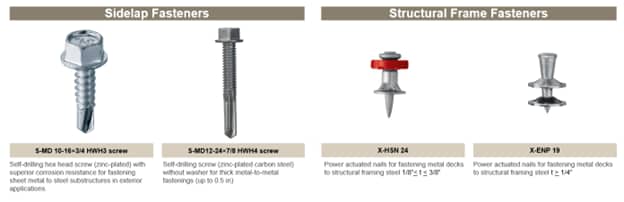
The test program included 16 series of tests with sidelap connections and 13 series of tests with structural frame fasteners. In their test, four types of sidelap connections were observed: top arc seam weld, screw, button punch, and the proprietary PunchLok II crimp. The sidelap screws chosen for evaluation from Hilti’s portfolio: S-MD 10-16×3/4 HWH3 screw #10-16 and S-MD12-24×7/8 HWH4 screw #12-24.
Structural connector tests included powder-actuated fasteners, arc spot welds, and arc seam welds. There two different types of PAF connectors, Hilti X-HSN 24 and Hilti X-ENP-19 , connecting to 0.189 inch and 0.25-inch frame elements (substrate plates) simulating the base steel frame, respectively, were tested. Both nestable and interlocking wide-rib (WR) decks within 22-16 gauge were considered.
The test setup was based on the lap-joint shear procedure according to the AISI S905-17. A test specimen is a single-lap joint using two steel deck components connected with two fasteners. One of the decks is connected to the moving portion of the rig, that reacts forces applied by test machine actuator. The stationary portion is fastened on the base by high-strength bolts. The load cell installed between the actuator and the moving part of the rig recorded the force response of the specimens, and the rig displacements were recorded through position transducers. Typically, three specimens were tested cyclically according to the FEMA 461 loading protocol and one specimen was tested monotonically for each type or configuration of a connector.
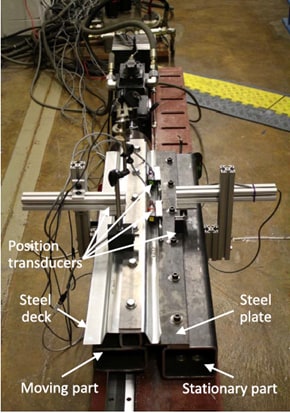
Test rig per S. Torabian, B. W. Schafer, Cyclic Experiments on Sidelap and Structural Connectors in Steel Deck Diaphragms.
Traditional welded fasteners have a lower ductility response to cyclic loading
The observed failure mode of the arc-spot weld used for structural frame fastening was a steel deck fracture around the spot weld. Out-of-plane deformation of the thin deck was evident and related to buckling on the side of the weld in compression/tension, there was no case of shear failure. The structural weld connections had significant capacity, but ductility and residual force capacity were very low which that makes the solution utilization non-optimal in the presence of seismic load.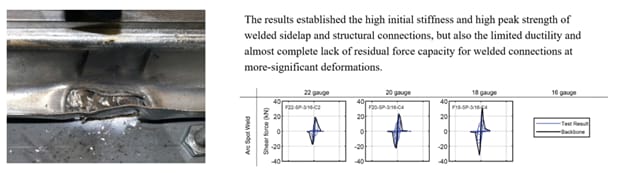
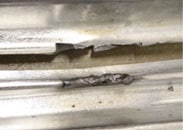
The commonly observed failure mode of the top arc seam welded sidelaps is plying tear and buckling underneath the top female plate. The first degradation in the arc-seam weld connection strength occurred after localized deformations of the steel deck around the weld and warping of the standing lip. As a result, the peak load decreased relatively sharply, however there was no weld failure observed in the tests. Both arc-spot and arc seam weld had high initial stiffness and high peak strength, but also limited ductility and almost complete lack of residual force capacity for welded connections at more-significant deformations.
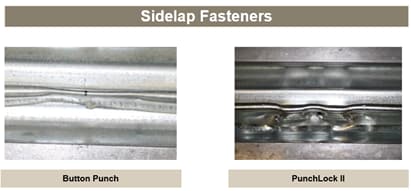
Button Punch and PunchLock II were tested to determine their ductility performance for sidelap fastenings
The failure of the button punch connector sidelaps occurred due to displacement of the tip of the crimped plate and causing friction between the male and the female plies. However, connections had a stable postpeak behavior and there was no plate plastic deformation or tear out observed throughout the test. The conclusion was made that the button punch as a sidelap could be ductile enough, but both strength and stiffness may be a limiting factor for the design engineer.
The failure of the PunchLok II crimp sidelap was not visible from the top throughout the test, but the local distortions at the crimp locations and the observations after removing the specimens from the rig showed that the male ply tore and the shear tabs eventually sheared off the male ply underneath the top female ply. In spite of this there was a ductile failure, due to gradual distortion and failure of the engaging sheets. The PunchLok II connector offered relatively higher capacity than screws but had only moderate ductility and provided strength and stiffness values similar to that of top arc seam welds, but with more than 2 times the ductility and residual force capacity of welds.
Mechanical Fasteners offer a more ductile response in dynamic loading conditions
The typical failure modes observed for powder-actuated nails tested was shear tearing with large deformation through the deck and bearing failure of the deck at the fastener location without failure of the nail itself. The controlling failure mode was influenced by the deck thickness. Shown in the image below, thicker gauges of steel sheets were characterized by slotting through the deck and piling up of the deck material. Meanwhile the thinner decks demonstrated slotting, then tearing and buckling of the sheet steel around the nail. Regardless of the steel thickness, both the X-HSN and X-ENP nails exhibited outstanding ductility and high levels of residual force capacity. This shows that powder-actuated nails fasteners, such as the Hilti X-HSN 24 and X-ENP 19, offer significant energy dissipation in the connection point for roof diaphragm thus offering a fastening method to designers offers a more ductile fastening. Despite the 2 times lower peak capacity, PAF structural connectors surpasses the welded structural connectors in this indicator. 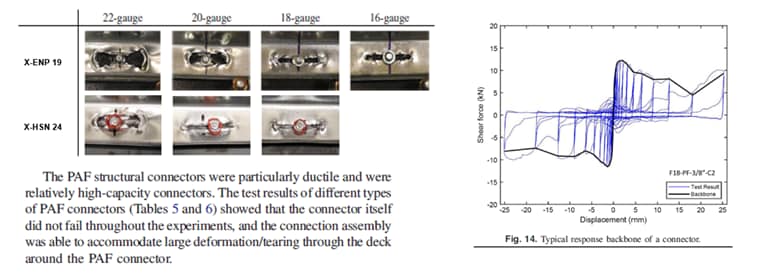
Hilti mechanical frame fastener image and comments per the Cyclic Experiments on Sidelap and Structural Connectors in Steel Deck Diaphragms test by Torabian, S. and Schafer, B. W., ASCE Jan, 2021
Similarly observed for mechanically fastened frame fasteners, the screwed sidelaps failed by screw tilting and bearing with large cyclic displacements around the fastener. Due to the displacement, the screws were backing out of holes irreversibly with a large tilting angle. As the result, the backout ended in the removal of the screw. From the connection properties perspective, the screwed sidelaps had lower capacity than welded sidelaps, but significantly more ductility.
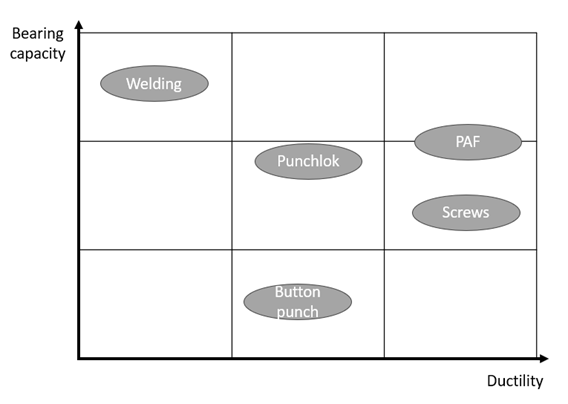
The research and findings from S. Torabian and B. W. Schafer shows that the combination of powder-actuated nails as the structural connections between steel deck and framing; and nestable screws as sidelap provides the best combination of ductility and residual force capacity in comparison to welded fasteners. The combination of powder actuated frame fastener and screwed sidelap connections also offers reasonably high levels of initial stiffness and strength when paired together for a diaphragm design. It is reasonable to continue investigations with nonlinear time-history analysis simulations of buildings with bare steel deck roof diaphragms and check ductility benchmarks settled by the relevant design codes.
Resources
Get started designing a roof or floor diaphragm using the PROFIS Engineering Diaphragm Design Module Register now and get started
Learn how to design steel deck and concrete-filled roof deck with our PROFIS Engineering Diaphragm design Software demonstration video.
Learn more about our steel deck fastening systems with our Direct Fastening Technical Guide.
Already familiar with Profis Engineering Diaphragm Design Module? Check out our PROFIS Engineering Diaphragm Design Guide which provides design examples of simulated roof and floor deck attachment design using the software using the standards of AISI S100, AISI S310, and SDI DDM04.
References
American Society of Civil Engineers, ASCE/SEI 7-22, “Minimum Design Loads and Associated Criteria for Buildings and other Structures.
S. Torabian, B. W. Schafer, Cyclic Experiments on Sidelap and Structural Connectors in Steel Deck Diaphragms (The explicit research findings, test data and other relevant information could be found in the original paper or requested from the corresponding author via torabian@jhu.edu upon reasonable request.)
