
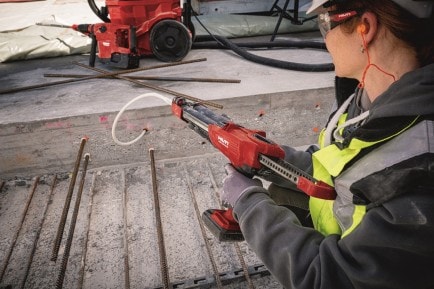
Development length provisions for post-installed rebar used in extension applications
The American Concrete Institute (ACI) standard titled Building Code Requirements for Structural Concrete (ACI 318) includes provisions for reinforced concrete design. These provisions are written for cast-in reinforcing bar design; however, post-installed reinforcing bars that demonstrate equivalency to cast-in bars can also be designed for development with these provisions. This paper will discuss how the development and splice provisions given in ACI 318-19 Chapter 25 can be used to design post-installed reinforcing bars for a tension lap splice.

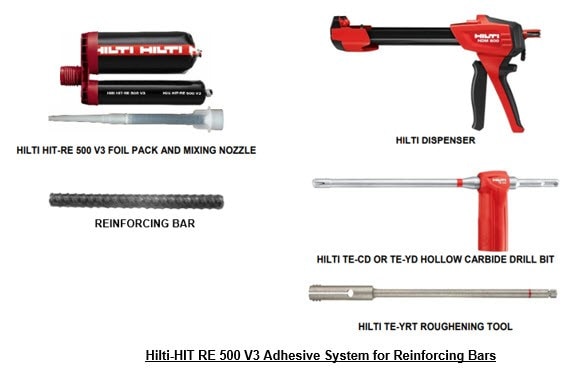
The International Code Council Evaluation Service (ICC-ES) writes what are known as “acceptance criteria” to permit the evaluation of products for recognition “in the opinion of ICC-ES” under the International Building Code (IBC). IBC recognition is provided via an ICC-ES evaluation report, also known as an “ESR.” The ICC-ES acceptance criteria for evaluation of adhesive anchor systems under the IBC is titled Acceptance Criteria for Post-Installed Adhesive Anchors in Concrete Elements (AC308). Evaluation per AC308 also provides product-specific data and provisions that can be used to design the adhesive anchor system with ACI 318 provisions. Reinforcing bars successfully evaluated per the test program outlined in AC308 Table 3.8 can be post-installed as part of an adhesive anchor system in which the bars are designed using ACI 318 development and splice provisions (e.g., ACI 318-19 Chapter 25 provisions).



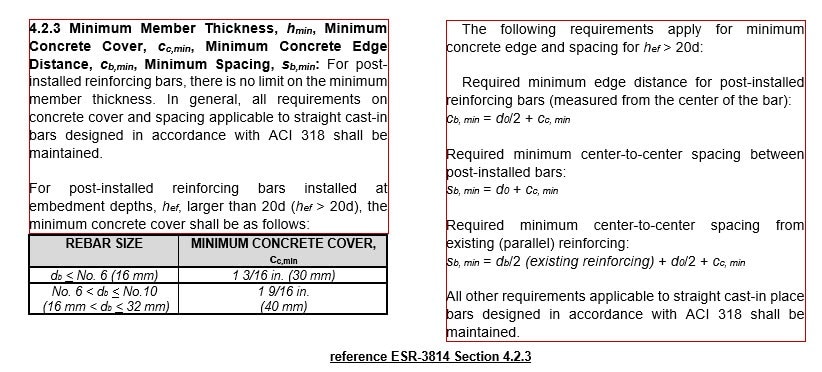
Below is an excerpt from ESR-3814 (HIT-RE 500 V3 adhesive) showing the cover and spacing requirements for post-installed reinforcing bars being designed for development. The test programs outlined in Table 3.8 of AC308 are predicated on bar embedments greater than 20-bar diameters (20db in). ACI 318 cover requirements are predicated on the amount of concrete between the outside of a bar and the concrete surface, and spacing requirements are predicated on the clear spacing between bars. It is important to note that cover requirements derived from the AC308 evaluation are predicated on the distance from the center of the post-installed bar to the concrete surface, and spacing requirements derived from the AC308 evaluation are predicated on the center-to-center spacing between bars. The parameter “d0” noted below corresponds to the drilled hole diameter (d0 in) for the post-installed reinforcing bar, which is different than the bar diameter (db in). Values for d0 are given in the ESR. Also, note that the spacing requirements between two post-installed bars differ from the spacing requirements between a post-installed bar and an existing cast-in-place bar.
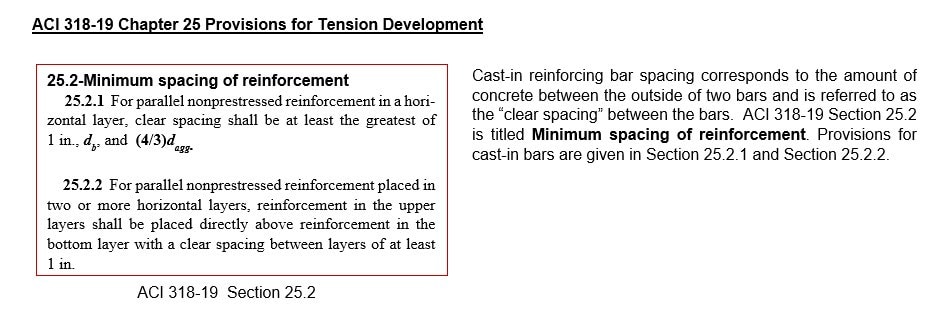
ACI 318-19 Section 25.4 contains provisions for developing cast-in reinforcing bars. These provisions will be explained below, keeping in mind that post-installed reinforcing bars qualified per the test program outlined in AC308 can also be designed with these provisions. Any exceptions to these provisions with respect to post-installed bar design versus cast-in design will be noted. In the context of this paper, the discussion emphasis will be on those sections in Section 25.4 that are relevant to straight bar tension reinforcement designed for development.

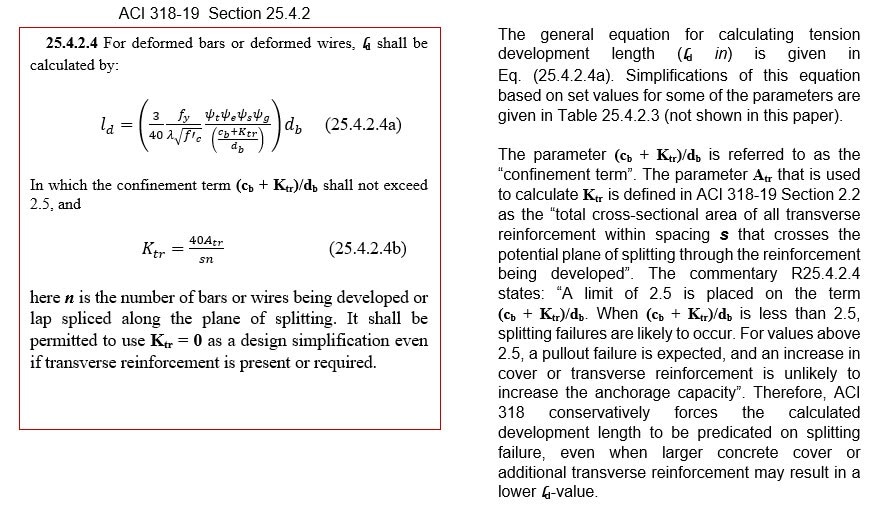
The parameters given in Eq. (25.4.2.4a) are defined in Table 25.4.2.5. These parameters are explained in detail below.

ACI 318-19 Section 25.4.3 includes provisions for designing a hook. Using a hook for reinforcement design permits a bar to be developed when there is insufficient concrete to develop a straight bar. Figure 1 shows the red bars' calculated straight bar tension development length (ld in). This length is greater than the grade beam thickness of 36 in. Therefore, a 900 hook can be used to develop the bars in tension. Figure 2 shows the hook length (ldh in) calculated per the provisions given in Section 25.4.3.1 and the parameters defined in Table 25.3.1. When designing a post-installed reinforcing bar for development, only a straight bar can be installed in the hole that must be drilled into the existing concrete. Therefore, post-installed reinforcing bars cannot be designed with a hook at the end that is installed into existing concrete. However, a hook could be designed for the end around which new concrete will be placed.

ACI 318-19 Tension Lap Splice Provisions for Reinforcing Bars
ACI 318 includes provisions for splicing one bar to another to transfer load from one concrete member to another. Provisions for both tension lap splices (bars in tension are spliced to one another) and compression lap splices (bars in compression are spliced to one another) are included. This paper will discuss ACI 318-19 tension lap splice provisions.


Designing Post-Installed Reinforcing Bars for Development per ACI 318-19 Provisions
As previously noted, reinforcing bars evaluated in conjunction with an adhesive product per the test program outlined in AC308 Table 3.8 can be designed using ACI 318 development and splice provisions (e.g., ACI 318-19 Chapter 25 provisions). The design procedure can be summarized as follows.
1. Verify that the adhesive product has been evaluated per the test program outlined in AC308 Table 3.8.
Reference sections 4.2 and 6.0 in the adhesive product ESR.
2. Select a bar diameter and grade. Design the reinforcement per the provisions for the concrete member in
which it will be utilized, e.g., ACI 318 Chapter 7 for a one-way slab, ACI 318 Chapter 9 for a beam, etc. If the
design is satisfied, calculate the required development length, lap splice length, and detail the bars. Post-
installed reinforcing bars can only be designed as a noncontact lap splice.
3. Develop an installation procedure for the post-installed bars that follow the Manufacturer’s Printed Installation
Instructions (MPII). The installation procedure should also include location of existing reinforcement, drilling
method (e.g., hammer drilled or core drilled), cleaning procedure, and required gel/setting times for the
adhesive.
Summary
Adhesive anchor systems successfully evaluated per the test program outlined in Table 3.8 of the ICC-ES acceptance criteria AC308 demonstrate compliance with the IBC and performance equivalent to cast-in reinforcing bars. This is done so that the post-installed bars can be designed using ACI 318 development and splice provisions. The ICC-ES evaluation report (ESR) for Hilti adhesive systems will note if the adhesive product has been evaluated per AC308 Table 3.8. Reference Section 6.0 in the ESR. Section 4.2 in the ESR will state that the adhesive can be used to post-install reinforcing bars per the development and splice provisions of ACI 318. The attached example shows how post-installed reinforcing bars can be designed with a Hilti adhesive product per the development and splice provisions in ACI 318-19.
Additional Resources
Design Guides
Hilti Post-installed Reinforcing Bar Design Guide
Hilti Post-installed Reinforcing in Fire Conditions Design Guide
Design Software
PROFIS Engineering
Hilti Post-Installed Rebar White Papers
* Post-installed Reinforcing Bar Design Options: An Overview
* Shear Friction Design using the Hilti Method for Post-installed Rebar Design
* Design for Yield using Anchoring-to-Concrete Provisions for Post-installed Reinforcing Bar Design
* Extension Design using ACI 318-19 Provisions for Post-installed Reinforcing Bar
* Structural Joint Design using ACI 318-19 Provisions for Post-installed Reinforcing Bar
* Shear Friction using ACI 318-19 Anchoring-to-Concrete Provisions for Post-installed Reinforcing Bar Design
* Shear Friction using ACI 318-19 Provisions for Post-installed Reinforcing Bar Design
* Designing Rebar in Fire-rated Concrete-to-concrete Connections: Frequently Asked Questions
* Designing Post-installed Rebar for Fire Conditions using PROFIS Engineering Whitepaper
