
Testing and Design Parameters that Affect Bond Strength of Adhesive Anchor Systems
What should I specify when it comes to an adhesive anchoring system?
CSA A23.3-19 section D.10.2.2 acknowledges that the bond stress of adhesive anchors is dependent upon a variety of factors and requires structural engineers to consider and include those parameters in their design and specification. There are many factors, but three important and easily overlooked factors are:
- Concrete temperature range at time of installation
- Moisture condition of concrete at time of installation, and
- Hole drilling and preparation

Where can I find information about how these factors are addressed in my adhesive anchor design?
CSA A23.3-19 states that the design information for a post-installed anchor approved for use in cracked and uncracked concrete tested in accordance with ACI355.2 and ACI355.4 shall be taken from a product evaluation report. One of these types of product evaluation reports is an ICC-ESR.
The International Code Council Evaluation Service (ICC-ES) writes acceptance criteria (AC) that reflects the provisions in ACI 355.4 Qualification of Post-Installed Adhesive Anchors in Concrete. ICC-ES likewise publishes an ICC-ES evaluation report (ESR) based on the acceptance criteria testing. These ICC-ES reports serve as a third-party evaluation with which engineers can compare engineered products. By meeting the Acceptance Criteria and having an ICC-ES report, manufacturers can demonstrate compliance per reference model code. Adhesive anchors are tested to AC308 Acceptance Criteria for Post-Installed Adhesive Anchors in Concrete Elements, and therefore to ACI355.4 Qualification of Post-Installed Adhesive Anchors in Concrete.
ICC-ES reports can include a vast amount of information:
1. Check Section 2.0 Uses to ensure the product you’re designing with is intended for your application. Considerations may include, but not limited to, base material type, cracked or uncracked concrete, or development length provisions with rebar.
2. Verify Section 3.0 Description includes the anchor element you intend to use; such as rebar, threaded rod or internally threaded inserts. Additionally, check the adhesive anchor system has been tested with dust-removal systems. While this may not be critical to you in the design phase, contractors may require the use of systems to reduce silica dust on jobsites based on CCOHS (Canadian Centre for Occupational Health & Safety) recommendations[i].
3. Read Section 5.0 Conditions of Use for applicable temperature ranges, installation orientations, and any other configuration requirements.
4. Read Section 6.0 Evidence Submitted to verify the product you are evaluating has been tested in accordance with ICC-ES AC308.
How can these factors influence adhesive anchor performance?
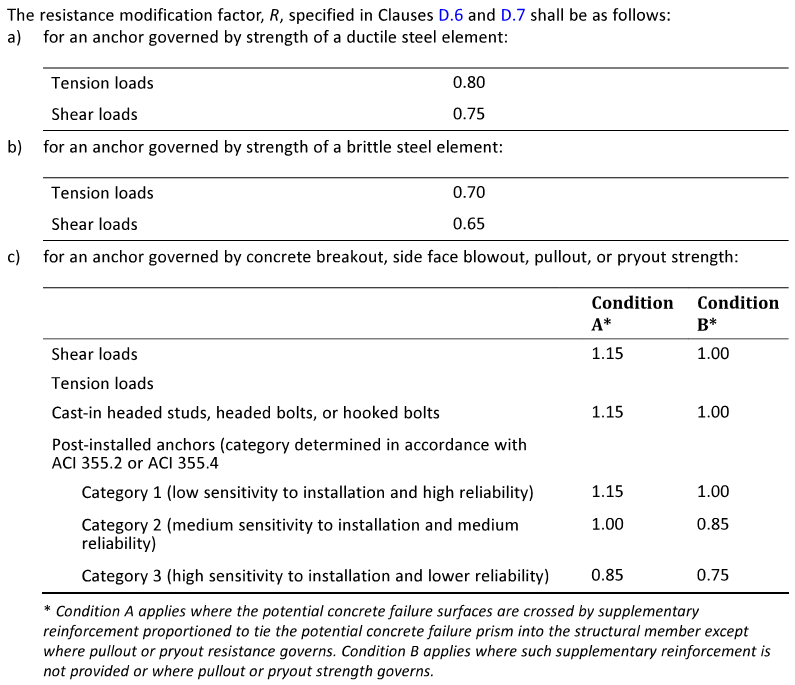
Through reference and reliability testing per ACI 355.4, resistance modification R-factors are assigned to adhesive anchor products based on anchor diameter, continuous or periodic special inspection, hole-drilling methods, or moisture condition of the concrete. Higher resistance modification R-factors are associated with adhesives that perform more reliably and demonstrate less sensitivity to different conditions.
So why are these three parameters so important?
1. Moisture condition of concrete
When adhesives are installed into concrete holes and cure, they form a bond with the base material to transfer load from the anchor element. The presence of water can affect adhesion to the base material.
Per ACI355.4 and AC308, anchors can be tested to varying moisture conditions, including dry concrete, water-saturated concrete, water-filled holes in concrete, and submerged holes in concrete. Each product’s ICC-ES or third-party approval report includes f-factors derived from testing in these conditions.
2. Temperature ranges
Adhesive anchors cure because of a reaction between a hardener and resin. That reaction can be accelerated or delayed depending on the temperature of the base material.
Temperature range impacts adhesive anchors in four ways:
a. Adhesives are tested within a limited range of concrete temperatures at the time of installation. These temperatures are relevant to most installation conditions, but it’s important to verify that the concrete temperature at time at which your anchor is installed is within this range. Concrete temperature at the time of anchor installation can be influenced by geography, climate, and season.
b. The time required for the adhesive to cure (cure time) will be longer at colder concrete temperatures and shorter at higher concrete temperatures. Reference the Manufacturer’s Printed Installation Instructions (MPII) for cure times.
c. The time permitted to install an adhesive anchor (working time or gel time) will also vary with concrete temperature. Reference the Manufacturer’s Printed Installation Instructions (MPII) for working times.
d. Some products require conditioning to certain temperatures. For example, an ICC-ES report or the Manufacturer’s Printed Installation Instructions (MPII) may state that the adhesive cartridge must be conditioned to 20 0C in base materials less than 20 0C in order to achieve performance consistent with the tested data.
3. Drilling and hole cleaning
When a hole is drilled into concrete, the hole surface may vary from rough to smooth depending on the drilling method. Additionally, the hole is likely to be filled with concrete dust and debris from the drilling process.
Hole cleaning steps typically consist of blowing out the hole with compressed air, brushing the hole with a steel wire brush, and blowing out of the hole again. This cleaning method can vary depending on the adhesive product. Reference the Manufacturer’s Printed Installation Instructions (MPII) for the cleaning method(s) specific to an adhesive product. Installer training on anchor installation per the MPII is also recommended.
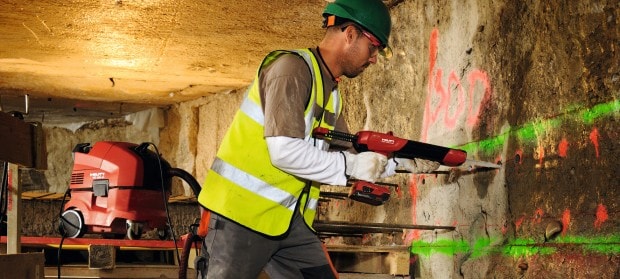
Hilti’s SafeSet System was developed to simplify the hole cleaning steps by using either (a) a hollow-drill bit and vacuum system that removes dust and debris during the drilling process or (b) a proprietary anchor element, such as a Hilti HIT-Z rod, requiring no hole cleaning to transfer load. Hilti and other manufacturers have developed virtually dustless drilling technologies for the purpose of silica dust removal, which is considered a health hazard and flagged by Canadian Centre for Occupational Health and Safety.
How do I fit all of this important information into my anchor specification?
1. Include “Basis of Design” parameters in your General Notes.
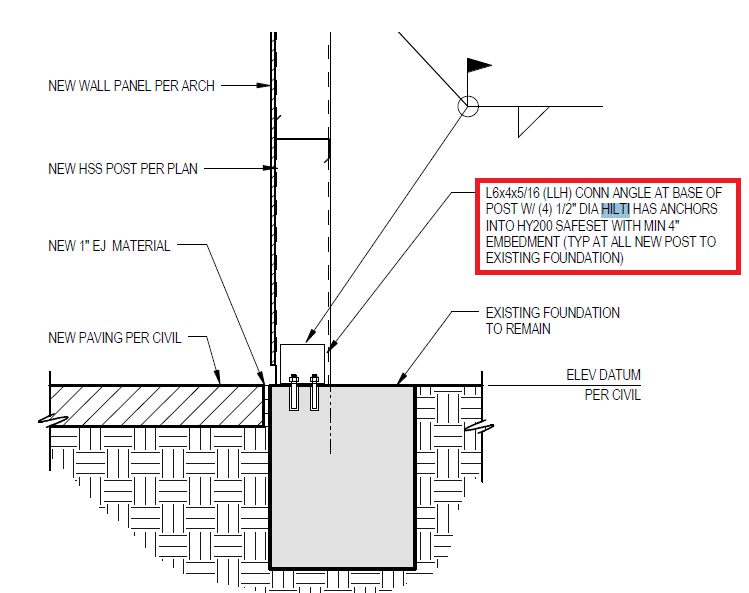
2. Call out the specific product, anchor diameter and embedment depth, and hole drilling and cleaning method directly in your details.
[i] https://www.ccohs.ca/oshanswers/chemicals/chem_profiles/quartz_silica.html
