

*This is part of a continuing series on rainscreen façades, for an overview of rainscreens please see the first article in the series.
Increasing requirements for noise protection
Across North America designers, building owners, and occupants have increasing expectations for acoustic performance in their homes and offices. Noise pollution has also increased as cities become busier with traffic and new construction nearby, but these external factors can be difficult for any city to control.
There are also various code requirements for acoustic performance in construction. The United States lists STC (sound transmission class) requirements for residential buildings, hotels, and motels in IBC-2018. Canada’s NBC 2015 uses ASTC (apparent sound transmission class) as a national model code, while the various provinces and territories have adopted additional requirements for the reduction of external noise.
However, it has become more common for building occupants to request noise protection above and beyond these model codes. The World Health Organization published a report in 2018 showing noise pollution can influence human health and well-being (1). Additional requirements in LEED V4 have also increased the importance of a façade that reduces external noise.
Testing rainscreen façades for noise protection
The acoustic performance of a façade can be a complicated topic, especially when considering the wide variety of popular façade materials. Hilti teamed up with panel producers, insulation producers, and the University of Vienna to better understand how rainscreen façade systems can affect sound resistances. 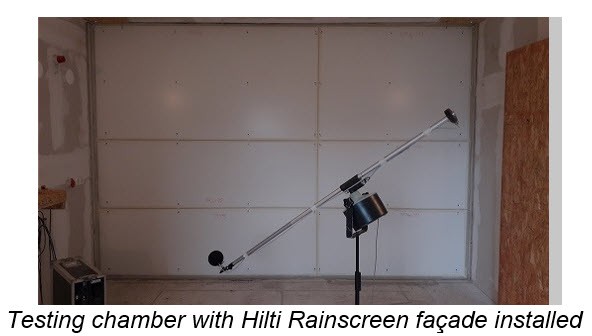
The project tested multiple configurations of insulation thickness and panel type according to EN ISO 10140-1; 2 to develop a methodology to calculate laboratory sound resistances, with the results tabulated below. 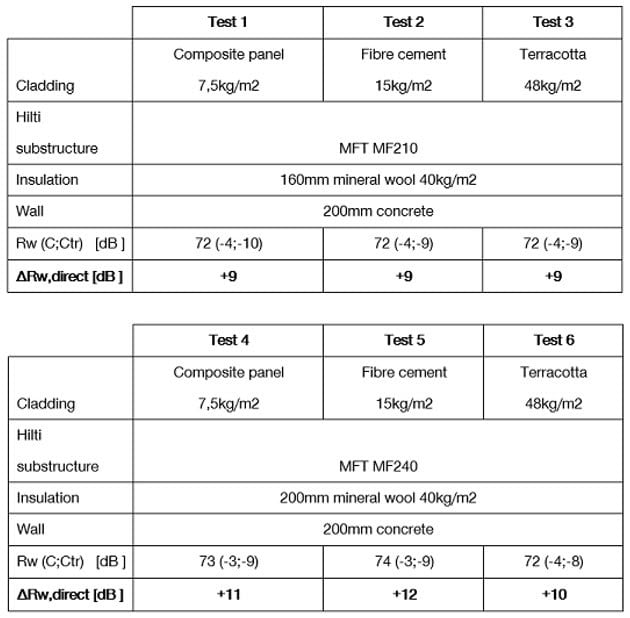
ΔRw,direct [dB ] is increase in sound resistance with façade compared to plain concrete wall without it.
Conclusions
Through testing, Hilti was able to find that rainscreen façades can increase sound resistance by up to 9-12 decibels, depending on the configuration of the system. While it may seem obvious that insulation should protect the building from noise, there are other façade panel systems, including foam board insulation systems, that can potentially increase the sound transmission of the façade!
Based on the results there are several interesting points:
- Improvement of sound resistance of original wall with Hilti rainscreen façade can go up to 9 to 12dB based on type of cladding and insulation thickness.
-Heavier cladding doesn’t automatically mean better sound insulation. We can guess that at a certain point stiffness of the substructure takes over and starts to play a role.
-Rainscreen façade provides very good sound resistance thanks to its non-homogenous structure and diversity of materials in each layer. Thus, covering a wide spectrum of sound frequencies.
-Weakest point of façade will almost always be windows and doors (typically in range of Rw=35-45dB) and their connections. To get a full assessment of façade sound resistance, all parts of façade would need to be included in a detailed calculation model.
Design with Hilti Support
Every project has specific needs and choosing a bracket can be difficult. Hilti has a team of engineers prepared to analyse your specific project and help you choose the correct bracket
Hilti Engineers can support you with:
- Attachment solutions for most common base materials and panel types
- Cladding view plans
- R value calculation in accordance with ISO 6946 and ISO 10211
- Structural design of the substructure according to IBC/NBC requirements
- Design of fastening based on sub material, possibility of pull-out tests in the field
- Installation documentation and training on site
To contact our façade consultants to discuss your project needs please visit our request form
For more information on simplifying your design process, see our article
For more information about rainscreen performance in fire, see our article on NFPA 285
For more information on how rainscreens can add usable space to your project, see our article
Sources:
(1): https://www.who.int/europe/publications/i/item/9789289053563
