
Adhesive Anchors: Fast Cure vs. Slow Cure
Choosing the right type of adhesive anchors depends on applications and conditions
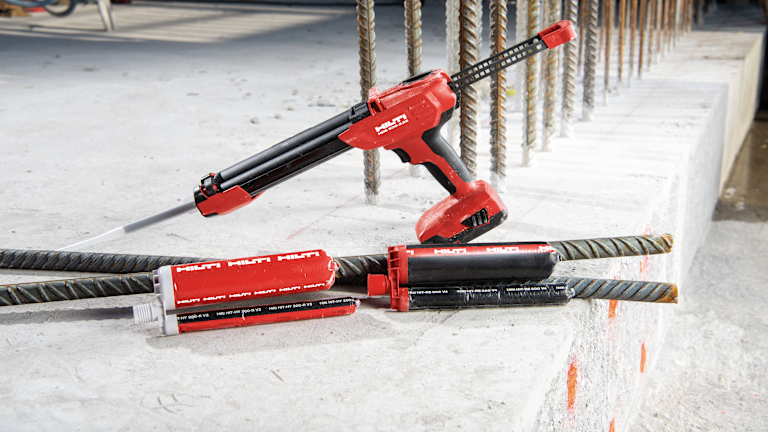
Fast cure adhesive anchors (e.g., HIT-HY 200) are hybrid adhesives characterized by rapid cure and work times which can lead to increased efficiency. Fast cure adhesive anchors are typically more suitable for small and medium bar diameters and shorter hole depths.
Slow cure adhesive anchors (e.g. HIT-RE 500 V3) are epoxy anchors characterized by longer working times. Slow cure adhesive anchors are generally more appropriate for large diameter bars in combination with deeper hole depths.
For example, if a rapid-cure adhesive is used for a large and deep bar installation, the time required to inject the adhesive may exceed the working time of a hybrid adhesive. In such cases it may be impossible to insert the bar fully into the hole . In particular, when adhesives are delivered in bulk quantities into a large drilled hole, the exothermic reaction associated with polymerization can result in a higher temperature rise which in turn can result in accelerated cure, further complicating bar installation.
Conversely, injection of adhesives under sub-zero conditions can result in elevated viscosity, likewise making manual adhesive injection and bar installation difficult or impossible.
Some basic considerations associated with adhesive selection include:
Can the adhesive be injected and the reinforcing bar installed within the gel time of the adhesive?
Are there constraints on time between installation and loading (i.e., cure time)?Is the appropriate injection equipment available, including all necessary accessories, to ensure correct dispensing and mixing?
Is the adhesive suitable for the concrete temperature and moisture conditions, hole orientation and drilling method?
What mechanical effort or equipment is required to inject the adhesive and to install the reinforcing bar into the adhesive-filled hole?
How will the bar be held in place during adhesive cure?
What are the load conditions? Tensile/shear loads (and whether sustained), seismic, cracked concrete… If the product has an ICC-ESR, the Report will contain information on the conditions the product has been tested for
Installation, and short and long term in-use, temperatures
What is the base material?
Please visit our Anchor Design Center for information regarding post-installed anchoring applications.
To assist you in designing with post-installed adhesives, Hilti offers best-in-class design software, PROFIS Engineering. Hilti PROFIS Engineering is comprehensive design software for anchor design in concrete, masonry, and concrete-over-metal-deck base materials and includes a versatile load engine and various options for base plate analysis. PROFIS Engineering includes the Anchoring to Concrete provisions of the ACI 318 Building Code and the ACI 349 Nuclear Code and the Anchorage provisions of CSA A23.3 Annex D.
Included within PROFIS Engineering software are a number of powerful features, exclusive to Hilti, that greatly enhance the user's choice and efficiency. Users can design with Hilti mechanical and adhesive anchor systems as well as cast-in-place headed studs and headed bolts. Tutorials explain how to navigate within PROFIS Engineering. The PROFIS Engineering Design Guide is an innovative, interactive tool that explains ACI 318 Chapter 17 strength design calculations and PROFIS Engineering design assumptions.
Please visit our Rebar Design Center for information regarding post-installed rebar applications.
Hilti is the first manufacturer to offer a software solution for the post-installed rebar application. PROFIS Rebar is a web based design software that allows engineers to design post-installed rebar using the only two approved adhesive anchor systems on the market, HIT-HY 200 and HIT_RE 500 V3. PROFIS Rebar calculates tension and compression lap splice lengths, development lengths for starter bars, development lengths for special moment frames and special structural walls, and development lengths for shear dowels. PROFIS Rebar also calculates post-installed reinforcing bar embedment based on research conducted using shear friction theory.
Looking for a someone to lay it all out? Check out our Anchor Selector Chart for a thorough overview of chemical anchors, steel elements, and mechanical anchors.