
What is the Hilti HDA Undercut Anchor and When Should Engineers Use It?
Learn how the updated ICC-ES ESR-1546 evaluation report enhances Hilti HDA performance, reduces edge and spacing requirements, and supports high-capacity static, seismic, and nuclear applications.
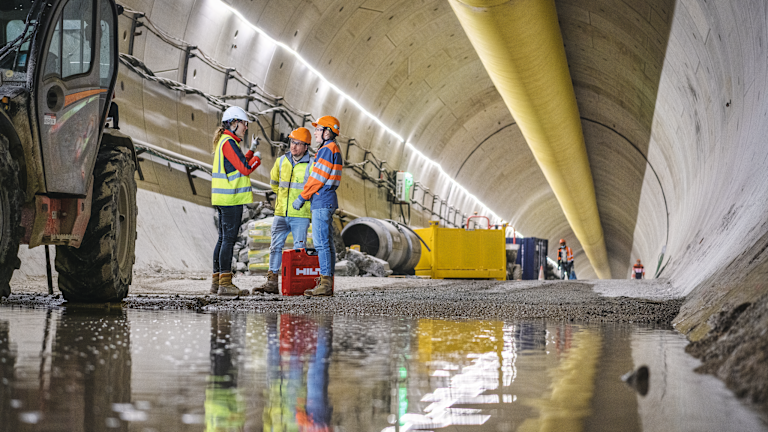
Learn how the updated ICC-ES ESR-1546 evaluation report enhances Hilti HDA performance, reduces edge and spacing requirements, and supports high-capacity static, seismic, and nuclear applications
Summary
The Hilti HDA is a post-installed mechanical undercut anchor designed for high-capacity static, seismic, and dynamic loading applications in cracked and uncracked concrete. The updated ICC-ES ESR-1546 evaluation report reduces minimum edge and spacing requirements, supports more efficient designs, and enables engineers to use HDA in applications where conventional post-installed anchors may be limited.
What is an Undercut Anchor?
Undercut anchors rely on the interlock of the anchor with deformations in the hole wall to resist the applied loading (Fig. 1.1). The anchor features an undercut sleeve that, when tightened or activated, engages the undercut and creates a defined mechanical interlock with the concrete, ensuring load transfer primarily through bearing rather than expansion. Undercut anchors rely on the interlock of the anchor with deformations in the hole wall to resist the applied loading. The bearing stresses developed in the base material at the interface with the anchor bearing surfaces can reach relatively high levels with minimized crushing due to the triaxial nature of the state of stress.

Fig. 1.1: Undercut of concrete created by the anchor (Hilti HDA) or installation tools
In recent years, there has been a growing demand for the use of Hilti HDA undercut anchors for structural and non-structural applications as projects have become more complex and load demands have increased. In response, as of 02/04/2026, Hilti HDA technical data published in ICC-ES ESR 1546 has been upgraded to better support designers with higher performance for their connection design. The Hilti HDA anchor offers high-capacity performance in static and seismic design compared to other post-installed anchor options, is tested to comply with the model code requirements, and offers reduced edge and spacing requirements to support those projects that have high demand loads or geometrical limitations.
Customer benefits of using HILTI HDA and Spec2Site offerings
The Hilti HDA undercut anchor comes with a complete SPEC2SITE offering with the design integrated in PROFIS Engineering software based on latest data as per ESR-1546, technical content in our Engineering Center and support extended from office to jobsite by the sales and engineering team. When structural designers use Hilti HDA SPEC2SITE offerings in their application, it helps them to design better connections (Table 2.1).
Table 2.1: Hilti HDA SPEC2SITE offering helps customers design better specifications; higher performing, value engineered and more sustainable with more peace of mind

Hilti HDA anchors are made of carbon steel, sherardized and stainless steel and available both in pre-set (P/PR) and through-set (T/TR) version (Table 2.2).In the case of the pre-set type, the anchor is installed first and then the fixture is placed in position. The holes in the fixture must exactly match the anchor location in the base material. In the case of the through-set type, the fixture is held in position and then the anchor is installed through it.
(Note: The sherardized versions Hilti HDA-PF and Hilti HDA-TF are not included in ESR-1546)
Table 2.2: Hilti HDA portfolio

What Applications are Suitable for the Hilti HDA Anchor?
Hilti HDA anchor is suitable for a variety of demanding structural and non-structural applications including nuclear power plants subject to static and dynamic loading (shock, seismic, fatigue) in cracked and uncracked concrete. Some of the key applications are as follows (Fig. 3.1):

How Does the Updated ESR Improve Anchor Performance?
Hilti HDA has several relevant evaluation reports for use in cracked and uncracked concrete under static and dynamic loadings (see Table 4.1) including the use in nuclear power plants under NQA-1 nuclear quality assurance program.
Table 4.1: Assessments for Hilti HDA

1.1 Improved pull-out resistance
The pull-out resistance values in updated ESR-1546 are not mentioned as they are not governing and hence pull-out failure is not decisive for Hilti HDA anchor as per new ESR-1546.
1.2 Improved Reduced Minimum Edge Distance and Spacing
After more detailed testing and assessment, minimum edge distance and spacing required for installation of anchors have been reduced to the allowable limit in updated ESR 1546 (Fig. 4.1). With the new improved reduced edge and spacing requirements, the hmin of Hilti HDA supports the use of Hilti HDA in thinner concrete slabs.

Conclusion
Key Takeaways:
Hilti HDA is a high-capacity mechanical undercut anchor for demanding structural applications.
The updated ESR-1546 provides reduced edge and spacing requirements, improving design flexibility.
HDA is qualified for use in cracked and uncracked concrete under static and seismic loading conditions.
PROFIS Engineering software includes integrated HDA design capabilities.
The anchor is well suited for structural steel, industrial, infrastructure, energy, and nuclear applications.
Consider designing with an undercut anchor when you have some or all the following conditions/ requirements:
Edge distance is limited.
High tension loads govern.
Cracked concrete conditions exist.
Seismic qualification
Anchor spacing is restricted.
Nuclear applications
Click here for more details on anchors.
To start designing, click here for PROFIS Engineering.
REFERENCES
[1] | ICC-ES EVALUATION REPORT ESR-1546, ICC-ES, 2024. |
[2] | Report WC 12-01- A Review and Recommendation concerning testing compliance with USNRC General Design Criterion (GDC) 1, “Quality Standards and Records,” of Appendix A, “General Design Criteria for Nuclear Power Plants,” to 10 CFR Part 50, and ACI 349-01, Oklahoma: WOLLMERSHAUSER CONSULTING, 2012. |
[3] | ACI 349-01: Code Requirements for Nuclear Safety Related Concrete Structures, Farmington Hills: American Concrete Institute, 2001. |
[4] | ICC-ES Evaluation Report ESR-1546, ICC-ES, 2026. |